

This homemade banana wine recipe is NOT a short term project - it really smooths out and becomes a lovely wine after about a year of aging.
Originally Posted October 13, 2011. Updated 12/9/20

For one, by the time you’re ready to add the yeast to get the product started... well, you’re working with a liquid that just looks revolting. Muddy brown-grey dishwater looking stuff.
You add the yeast, cross your fingers, and hope for the best.
Then, the yeast starts acting on it. Oh BOY does it ever! I’ve never seen such violent fermentation before!
It really is a sight to behold.

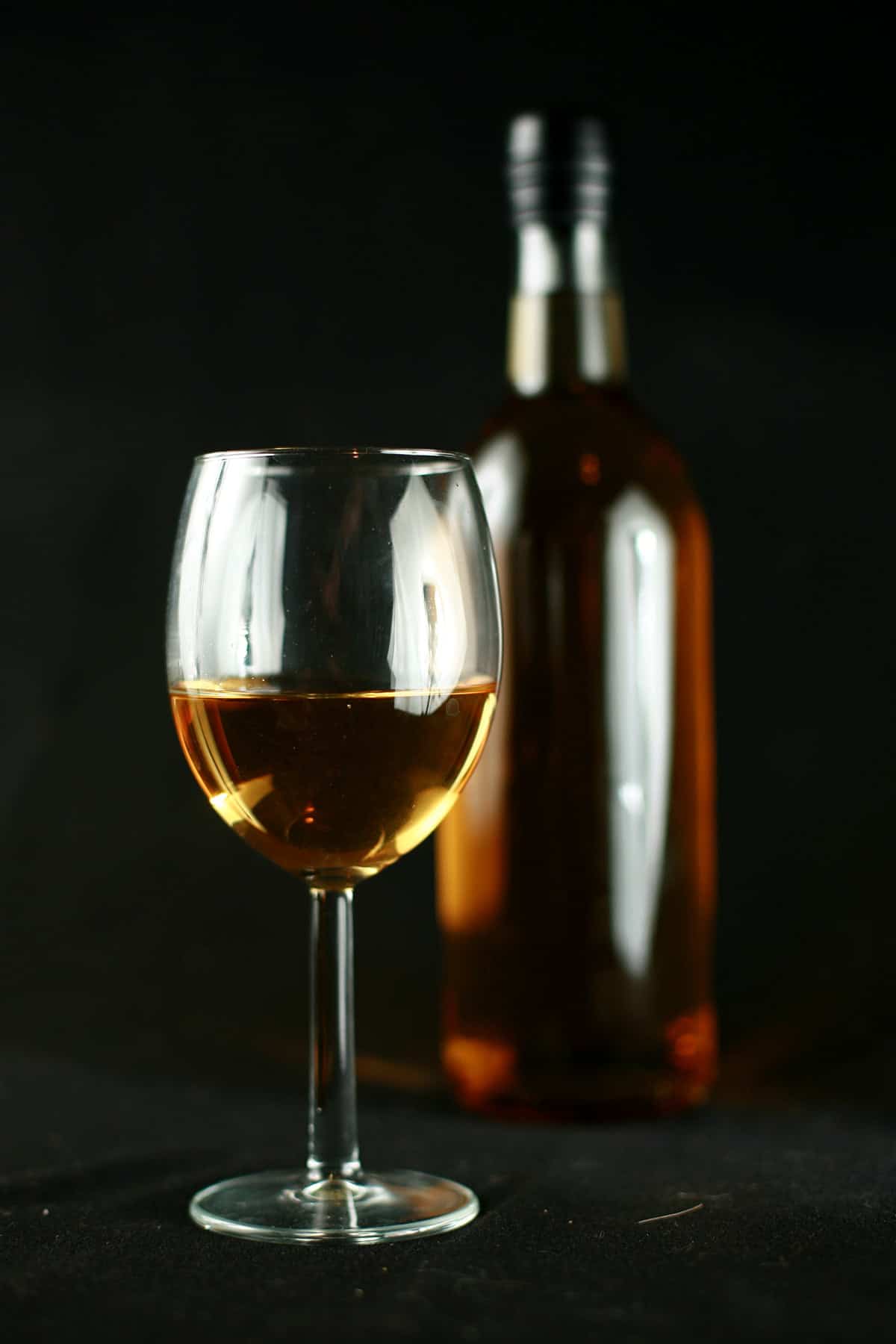
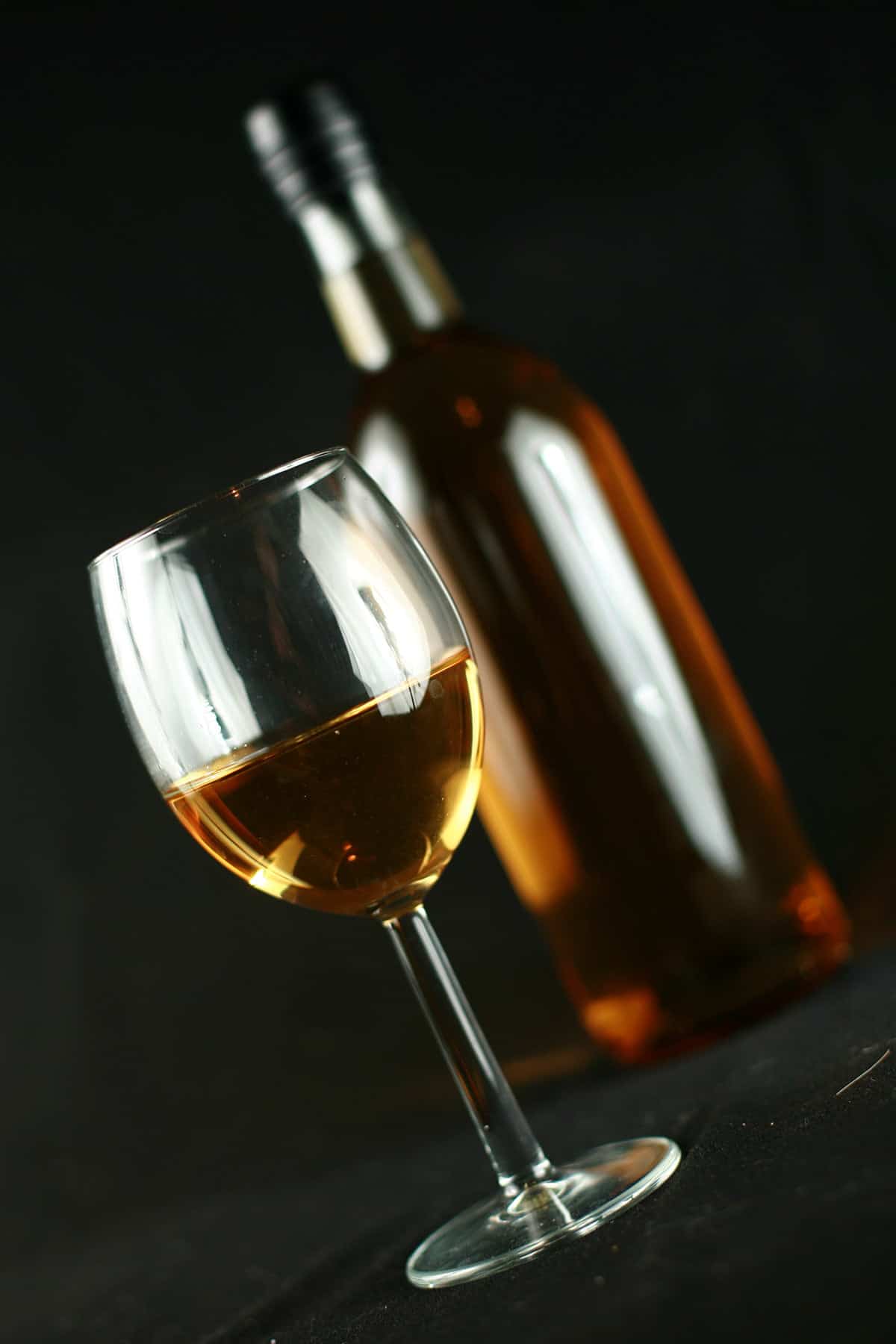
All of a sudden, that ugly, milky looking mixture clarified at some point. It left you with a gorgeous, brilliantly golden yellow and crystal clear wine.
No worries though - let your finished wine age for about a year after bottling, and you'll be rewarded with a smooth, flavorful wine that packs a punch! The harsh "Everclear" flavor will age right out.
This recipe is very easy - and very CHEAP - to make. Also, it finishes a unique color, which will make a beautiful addition to your wine rack - or gift.

How to Make Banana Wine
If you haven't attempted making wine before, don't be intimidated! Check out our primer to home brewing:
- Wine Making At Home, Part 1: Why?
- Wine Making at Home, Part 2: Equipment to Get Started
- Wine Making at Home, Part 3: The Brewing Process.
- Wine Making at Home, Part 4: How to Stabilize and Back Sweeten Wine
Just a small handful of entries, and you'll be good to go!

Banana Wine Ingredients
Bananas
You’ll want to use fresh, whole, RIPE bananas. Note quit “banana bread” ripe, but definitely heading in that direction.
The ripeness of your bananas will impact the flavour, sweetness, and ABV of your final wine, so it’s definitely worth holding off a few days, if your bananas aren’t very ripe.
Remove any stickers, wash the bananas, cut off the ends and discard them, and slice them up - peels and all. There’s a lot of flavour in the peels!
Sometimes the liquid will cook up relatively “clear”, like the top left image below. On other occasions - as in the top right photo - it’ll cook up to a very milky mixture.

It’s all good. As I mentioned before... this wine gets interesting!
It’s always fun to see which way it’ll start out, and watch the transformation from there.
Sugar
While sugar is technically optional when making wine, NOT adding any sugar will result in an INCREDIBLY dry wine.
When you’re making wine from bananas - much like with any other light coloured, non-grape fruit - you’ll want it to have at least some residual sweetness to it, or it just won’t taste like much. The sugar helps to bring out the banana flavour!
Sugar is an important part of wine making, and there are a few aspects of sugar to keep in mind:

Type of Sugar
In terms of type of sugar, we’ll swap between using plain white granulated sugar, brown sugar, or a mix of them.
Due to the robust nature of the banana flavour - and how much of it sticks around after fermentation - it can definitely handle the added flavour from a brown sugar.
I find that brown sugar - either in whole or in part - makes this wine smell and taste a bit more like a baked good, than when it’s entirely granulated white sugar used. It’s a bit of added complexity.
Conversely, using all white sugar will give you a wine with a “cleaner”, clearer banana taste.
Feel free to use either type, raw cane sugar, or a mixture of any/all of these.
Note: If you’re going for the brown sugar for some or all of the sugar, try adding a vanilla bean and a cinnamon stick to your boiled mixture, leaving them in through fermentation!)

How to Make Banana Mead
If you’d like to make a mead rather than a wine, you can swap the sugar out for honey. We’ll usually use 15-20 lbs of honey for this, if made as-is... though we’ll usually make meads in smaller batches. (3-5 lbs of honey for 1 gallon of water used).
A couple notes:
- I say “Banana Mead”, as that’s what most people would understand... but mead with fruit is technically called “melomel”.
So, swapping sugar out in favour of honey would give you a banana melomel. The more you know!
- In any mead or melomel recipe, you’re going to want to consider the flavour of the honey you’re using. Generally, we recommend using a fairly lightly flavoured honey - a clover or orange blossom honey, for instance.
Where white sugar is fairly neutral in flavour, honey can be aggressively flavoured, and that can compete with the fruit flavour. When it comes to banana mead, you have more leeway there - the banana flavour is INTENSE, so there’s more room to play.
Wildflower or buckwheat honey, for instance, are options. Buckwheat in particular goes nicely with banana, and doesn’t overwhelm the flavour.
Alcohol Content
Aside from flavour, there’s the matter of alcohol content.
Your wine’s final ABV will vary wildly dependent on a few things: The initial sugar content of the bananas you use, how much sugar you add, and what kind of yeast you use (more on that in a bit)
Any amount of sugar will result in a higher alcohol content than making the same wine without sugar added. Sugar - both in the base wine itself, and from the added sugars - is what feeds the yeast, the yeast eats up the sugars and gives off alcohol as the byproduct of that process.
More sugar = more food = more alcohol... to a point, anyway. About that...

Yeast
The type of yeast you use will impact the alcohol content of the final product.
Yeast organisms don’t have an *unlimited* capacity to process sugar into alcohol. At some point, the environment they’re living in - the brewing wine - becomes too high in alcohol for the yeast to survive. They die off, the fermentation stops.
Different types of yeast have different tolerances for alcohol in the environment. That is, some yeast will be able to survive higher amounts of alcohol in the wine, so they’ll continue producing it longer than some other types.
Some types of yeast will bring you to something like an 8% ABV, while others will let things run wild until close to 20% ABV.
It’s good to know what you have in mind, when you choose your yeast.
If you want a sweet wine with a low-ish ABV - without having to back sweeten it (more on that in a bit) - choose a yeast with a lower tolerance for alcohol.
If you’re looking for a dry wine with a low ABV, choose a yeast with a lower tolerance for alcohol, and don’t use a ton of sugar.
If you want a sweet wine with a high ABV, use a bunch of sugar with a high-tolerance yeast... and be prepared to backsweeten it.
If you want a dry wine with a high ABV, use a fair amount of sugar and a high tolerance yeast.

Scaling This Wine Recipe
As a note, you can easily scale this wine recipe up or down - in fact, there's a function inside the recipe card itself to do the math for you!
One note, though: You don't necessarily need to multiply or divide the yeast, but the software doesn't know that. We will use one full pouch of yeast for anything from 1-5x gallons, and then 1 pouch for every 5 gallons beyond that.
As a related note: The recipe software is definitely geared towards cooking, not wine making. Therefore, you can pretty much ignore all of the info it gives you: The nutritional info is calculated on everything that goes into the wine.
It does not take into account how much sugar will be fermented out, how much volume is lost to racking, the fact that the fruit pulp is removed before the final product, etc.
Back Sweetening Your Homemade Banana Wine
Sometimes - usually, even - you’ll find that the yeast went a bit too far with their smorgasbord, and you end up with a peach wine that’s not as sweet as you’d like it.
... and that’s when you back sweeten it! You can read my How to Stabilize and Back Sweeten Wine post for information on how to back sweeten it.
More Home Brewing Recipes!
While you've got your current homebrew fermenting away, why not consider putting a batch of something else on, to occupy your wait time? Here are a few of my other wine, cider, and mead recipes:
Wine Recipes
Blackberry Wine Recipe
Blackcurrant Wine Recipe
Blueberry Wine Recipe
Cherry Wine Recipe
Cranberry Clementine Christmas Wine Recipe
Cranberry Wine Recipe
Faux Lingonberry Wine
Lychee Wine Recipe
Mango Strawberry Wine Recipe
Mango Wine Recipe
Mint Wine Recipe
Lychee Wine Recipe
Partridgeberry Wine Recipe
Passionfruit Wine Recipe
Peach Wine Recipe
Stone Fruit Wine Recipe
Strawberry Wine Recipe
Ube Wine Recipe
Watermelon Wine Recipe
Mead Recipes
Black Cherry Mead Recipe
Blueberry-Clementine Mead Recipe
Blueberry Mead Recipe
Clementine Mead Recipe
Pumpkin Mead Recipe
Wildflower Mead Recipe
Cider & Miscellaneous Homebrew Recipes
Hard Apple Cider Recipe
Home Brew Hard Iced Tea Recipe
Maple Hard Apple Cider Recipe
Share the Love!
Before you drink up, be sure to take some pics of your handiwork! If you post it to Bluesky, be sure to tag us - @CelebrationGen. We're also on Pinterest, so you can save all your favourite recipes to a board!
Also, be sure to subscribe to my free monthly email newsletter, so you never miss out on any of my nonsense.
Well, the published nonsense, anyway!
Homemade Banana Wine Recipe
Equipment
- 7.5 gallon pot (or bigger)
- 1 6.5 gallon fermenter bucket and lid
- 1 or 2 6.5 gallon glass carboys & stoppers
- 1 air lock and stopper
- Siphon, siphon tubing.
Ingredients
- 21 lbs RIPE bananas Washed and sliced into thin rings
- 5 gallons Bottled water You won’t use it all
- 15-20 lbs White and/or Brown sugar We used white
- 6 teaspoon Acid Blend
- 5 teaspoon Pectinase
- 1.25 teaspoon Wine Tannin
- 6 teaspoon Yeast Nutrient
- 4 lbs Golden Raisins
- 1 packet Wine Yeast We like Red Star “Champagne” for this recipe
- Potassium sorbate or other wine stabilizer
Instructions
- In large stock pot – we used a 7.5 gallon turkey fryer – combine bananas, sugar, and about 4 gallons of water. Heat to almost boiling, mashing and stirring until sugar is dissolved. Continue to heat for about 45 minutes – never allowing it to come to a boil – stirring every few minutes. Remove from heat, add acid blend, pectinase, tannin, and yeast nutrient. Stir well.

- Place raisins in a freshly sanitized 6.5 gallon fermenting bucket. Carefully strain hot banana liquid into the fermenting bucket, over top of the raisins. Top with water to 6 gallons, and add a few scoops of the banana mush. Cover with sanitized lid and air lock, allow to cool to room temperature (overnight).

- The next morning, give the mixture a quick stir with a sanitized paddle, and – using sanitized equipment – take a gravity reading. Keep track of the number! (This is an optional step, but will allow you to calculate your final ABV %)
- Sprinkle yeast into fermenter, cover with sanitized cover and air lock. Within 48 hours, you should notice fermentation activity – bubbles in the airlock, carbonation and /or swirling in the wine must. This means you’re good to go!
- Let sit for about a week, stirring (sanitized paddle!) Every couple of days or so. It will get black on top. It’ll look awful… and your whole brewing area / basement / garage will smell like banana bread!
- After a week or so, use your sanitized siphon setup to rack the must into a freshly sanitized 6.5 gallon carboy. (At this point, we ran the raisins and remaining pulp through a juicer and added it to the carboy, but that’s entirely optional. Will give the wine extra body if you do it!)
- Put the carboy somewhere cool (not cold!), and leave it alone for a month or so.
- Using sanitized equipment, rack the banana wine off the sediment, into a clean, freshly sanitized 6.5 gallon carboy. (At this point, we added 4 lbs sugar for added sweetness. It probably also upped the final ABV!). Cap with sanitized airlock, leave it alone for another 2-3 months.
- By this point, you’ll find that your wine has clarified, and looks NOTHING like it did when it started. Enjoy your handiwork. Rack one more time, leave it for another 3 months or so.

- When your wine has been racked a few times and shows NO more fermenting activity for a month or so (no bubbles in the airlock, no more sediment being produced, you can move on to bottling.
- Follow the instructions on your selected type of wine stabilizer to stop fermentation. For potassium sorbate, this needs to be done 2-3 days before bottling.
- Using sanitized equipment, take a gravity reading, then rack the wine into clean, sanitized bottles. Cork.
- I’m not going to lie – the wine you bottle is going to be pretty harsh. Drinkable, but definitely banana flavored fire water. Put the bottles into the cases they came in and forget about them for a year (or two!) – you’ll have a much tastier wine at the end of the wait!





jen_alluisi
Perhaps I will just cross my fingers that I will get a gift of some banana wine, which sounds DELICIOUS...but we don't have the space (and if I'm honest, probably not the inclination) to make it ourselves. My mother-in-law likes this kind of thing, though...
Julie
I'd be interested in seeing a recipe converted for smaller batches. At the moment I only have 5 gallon equipment and as much as I like banana, I would prefer to try it first as a much smaller amount, say a growler or so. Though I suppose my lazy ass can do the conversions myself.
Jeff
I made my banana wine in my champion jucier. I removed stem and cut in half and put them through jucier then put in water with sugar on stove for 45 min low tempure and stired alot then I put the thick mess through jucier and poof I had great clean stuff beats the muslin all to heck
mike
i make this wine frequently i buy up ripe bananas in the super markets its an easy wine to do, good flavor, plenty of body, a very usfull wine
Rosa
mine went cloudy after bottling. i've made wine since the 80's and am confused as to why this has happened? Any Ideas please?
Marie Porter
... No idea. Haven't seen that happen, or heard it happen from anyone else. Maybe some bacteria got introduced at some point?
Larry Riach
Sometimes adding a little more pectic enzyme will help , it worked for me .
Kevin
Had the same thing with my first one. Add a bit more pectic enzyme next time, should clear that up. It's called pectic haze. Doesnt hurt the flavor, just look a different direction when taking a sip.
Chris
This hazyness tends to drop as sediments settle down if the wine is kept still in a particular place without interference. This take some time though. Aging it at around 14°C should fasten the process.
Teresa
Can I use my frozen bananas for this recipe?
Marie Porter
Definitely!
mike
never got to finish above post , a very useful wine for blending to other white wines needing more body,
Laurie
I was given a case of bananas, so I put the whole thing into the deep freeze for a week, then peeled the bananas and have followed your recipe, it smells good right now!
robert
Followed the recipe to the letter only thing is, (needing bifocals), I didn't think to look when I was weighing my bananas and instead of lbs, I had kg on the scale, so my 21 pound batch ended up being 40lbs. The supermarket was singing, "Yes, we have no bananas, because robb can't follow a recipe today". Anyhow, since I was using a sankey key to cook in, I just doubled everything else and now I have two fermenters full of banana wine! Christmas presents, yeah, Christmas presents! The sankey keg was great, it was free from a neighbor complete with 12 year old aged beer in it when I cut the top off. 15 gallons of stainless steel with handles. Works better than a turkey pot.
robert
What the? I'll try again. accidently doubled the recipe using kg instead of lbs so now I have 13 gallons!
Gerald J
I am deffenatly going to make the Banana wine useing your recipe I have often wondered if one could make banana wine and how would it tast ! So I am going for it THX FOR THE RECIPY AND DIRECTIONS
Steve
I like the idea of a banana wine, and am definitely going to ferment a batch up. A friend just told me he started one.
Just have a couple questions:
How ripe is too ripe (or is it, it can only be too green)? In your pics you posted, the bananas skin is just getting spotty.
One poster said she put bananas in freezer, no doubt this turns these suckers black & are then super ripe. Also she peeled the bananas.
Are there no off flavors produced with the skin on?
And some of you run the skins through the food processor or juicer along with the fruit??
Seems like eliminating the peelings would be the correct thing to do to eliminate the bitters of the peel?? Am I missing something here. Or I guess the other half of that question is: Do the peelings impart favorable things to this wine (fermentables, flavor, what)?
Has anybody done this recipe EXCLUDING the golden raisins& if so how does it alter the final products flavor or what? It seems like the only reason for them is to punch up the alcohol content.. is that a correct assumption?
Also for the yeast, I'm leery of the champagne yeast, from my memory that yeast rocks out the fermentation super fast and maybe that's where your getting your higher alcohols that take so long to age out?
I like the Lalvin & use D-47 for most of my fruit wines & have used Lalvin EC-1118 for an apple butter cyser, due to the higher alcohol content & that yeast handles that quantity of fermentables nicely. EC-1118 processes comfortably to 18% alcohol content, if I kill the raisins, that would probably drop 4 % off the final ABV content & work for this.
I'd really appreciate any and all feedback on these questions, I'm seriously anxious to get a batch of this started!
Steve
Richard
The skins add to the flavour
godfrey
am happy to read this information am interested to start producing banana wine for business can you give me ratios to produce wine in lager volume
Marie Porter
Hi there! Thanks for your interest in Celebration Generation!
I do make myself available for business consultations in situations like yours, please contact me by email to discuss!
Blog at celebrationgeneration dot com
Jo
Hi from Australia, as to why this post may have blown up. There was a police show on tv tonight 1/3/2021 where a man was pulled over for a breath test he blew positive when asked what he had to drink he said banana wine. Im guessing like me not a lot of people have heard of it and have googled banana wine your post is the first to come up.
Marie Porter
Hello!
Thanks for letting me know! Whenever something randomly goes wild, it's always interesting to hear about what inspired the surge. Last time, it was a reality TV show talking about a type of eggs benedict... that had my Halifax style eggrolls (??) blowing up.
Thanks again, hope you guys are staying safe down there!
Chrissy
Did you end up making it? Would LOVE to hear your feedback ❤️
Donovan
Great! Cant wait to start this this weekend!
Poppington
I basically added about 6 hands of bananas maybe about 50 bananas and a kilo of sugar foolishly I over filled the bucket. I instead of boiling them I used a liquidiser boy did that foam up I had 3 over flows and had to split it between two buckets. The only thing I added extra was about half a bottle of lemon juice. I will let ya know how it went.
Dan
Has anyone tried this mixing half and half with strawberries? I'm boiling bananas as I type. Will follow the recipe till somewhat cooled, then add mashed strawberries. Strawberries don't get boiled. Strawberry wine comes in as one of my favorite wines to make. I,ve never tried banana or any wine or that has to be cooked. But I love strawberries and bananas together, so we'll see.
Marie Porter
Hi Dan... I'd make the banana and strawberry wines separately, and then mix them later on - would be easier to achieve a desired flavour balance.
The Mackem
ok, I have just syphoned the must into my carboy and in one month syphon from the sediment. At that point you added 4lbs of sugar. If we normally like Chardonnay, how much sugar should i add at that point.
hawaiianbrian
Actually brandy is made from raisins. Also, I freeze my bananas and they don't turn dark. Simmer with the sugar and no yeast. Maybe takes longer. For me it doesn't have to be clear to drink, like apple cider. But I have tasted 20-30 year old banana wine home made. World Class Stuff. hawaiianbrian
linuxfueled
great recipe,
Worked flawless and the smell is great after 2 months. Let you all know in a year or so how the taste is:)
Phil
Actually following this recipe right now. Going to bring it out of the fermentation bucket right now. I just wanted to thank you for the recipe! Been having fun doing it!
wtfh
good looking lady making great wine !
phil
This recipe I followed to the t. Finished, bottled wine is amazing, liquid gold. Thank you!
Marie Porter
Enjoy!
Errol
Is there anyway to have a much shorter fermentation time?
Marie Porter
I wouldn't recommend cutting the fermentation any shorter. It really needs the time to do its thing.
Tom
How about making a hard Apple cider using bananas? How would I do this? I assume using frozen bananas as mentioned above but would I still need to add sugar etc? Any ideas would be appreciated. Cider us in carboy waiting Instructuring.
Marie Porter
I'd probably add a fairly small amount of fresh bananas in with the primary cook/fermentation - not sure how it would go if you've already got the apple fermenting?
olly
try adding 6lb`s of coconut too,either the shop bought flakes or fresh......makes a beautiful full bodied wine,with exquisite flavour...takes 7 months to mature in the bottle,but i am sure it would be even better after a year or so....
Marie Porter
Ooh, that sounds amazing! We'll have to try it next time we put a batch on!
Brent Atkinson
I find this recipe intriguing but would like to know if this is a sweet or dry wine. Before breaking down your ingredients measurements to fill a 55 litre carboy I'd like to know how it should taste.
Marie Porter
Definitely a sweet wine.
Andy
Hi Marie, I have just started two batches of your banana wine. I generally make crab apple. Have been excited to start this batch. Just stumbled across your recipe and it sounded very good. Thank you for sharing it and I will let you know how it comes out.
Marie Porter
Awesome! I look forward to hearing about it!
Rila
I doubt this wine came out anywhere near 20%! Red Star Champagne yeast only has an alcohol tolerance of 13-15%.
Marie Porter
*shrug* doubt all you want, but it comes out consistently right around 20%. Why not try it and see for yourself?
Rila
OK, I believe you. I just can't figure out how it can come out higher than the tolerance of the yeast ;).
Marie Porter
I'm guessing the tolerances aren't *super* accurate, and probably under-promise due to variability in batches?
All Home Brew Supplies
Banana wine is one of my favorite flavors. I'd never tried a formulation for this at home yet, and Im yearning to brew some.
Isaac Agyare
I am excited about this blog. I have a farm 100 acre farm with mangoes, coconut and bananas. My intention is to go into commercial tropical fruit wine making, how do I start?
where do I get my supplies, equipment and ingredients. Any short course or books needed?
Marie Porter
I have no real experience with commercial wine making, so I am the wrong person to ask. Have you tried contacting a winery to see if they'd be willing to give you some pointers?
Robert Romney
Started making wild fruit wine about five years ago in northern Alberta. Now live on an acerage in southern Costa Rica where we have 20 banana plants which produce large amounts of fruit. What to do with it? Banana bread, sell some, well how about banana wine?
Cellars Wine Club
Wow! That is a clever idea. Banana wine is very interesting, plus the tutorial on how to make it makes it more appealing. A must try recipe!
mike
recipe I saw for banana beer involved the village women chewing up and spitting out the bananas into gourds , and leaving those hanging up over the goat hut !
Chris
Hey, trying banana recipe, just racked after fermentation, looking just over 20%, taste so far is a little on the acidy side, doesn't taste harsh al
At all, I'm sure will sweeten after next racking, just worried about the balance.
Jim
So you leave the peel on the banana when you slice it and boil the peel too?
Marie Porter
Yep!
Marc Lure
It looks like so much fun! I hope my batch comes out as good as yours did.
Bjorn De Boeck
Hi! I have had my wine bubbling for a while with the water lock and it stopped a couple of weeks ago so I'd like to bottle soon. I had a little taste and while there is definitely a good alcohol content, it is pretty sour. Not bitter, sour. The bananas were ripe and I added panela (raw sugar cane blocks). I used my own natural yeast that I use for all ferments. I get a whopping 10% ABV with it and it always gives me great flavor. So, why the sourness??
Marie Porter
We've never had that happen. Without having been there, I'd guess it's the yeast used, or that some bacteria got in at some point.
Chris
Help, after about 2 weeks after first raking, looks like something from aliens, clear in spots, but has formations in in????
Roxanne G
Hi Chris,
In my demijohn I have the cloudy formations also. I squeezed the liquid out of my cheese cloth and think it's banana that's left behind. I'm trying to get an answer also. The clouds are on top and bottom with clear amber yumminess between. Let me know what you find out!
bev
I made a beautiful batch of banana wine accidentally, just by leaving the bananas in a closed container . I drained and strained then added sugar to the juice, sealed and left foe about three monts to see what would happen. Result, a most delicious tasting licgour. Now I am looking on new ways to compare
Bob
I found a 5 gal. oak barrel at an estate sale and was wondering if I could ferment this wine in it or rack into it at some point for an oak flavor. I've never used a oak barrel with wine any input would be appreciated
Marie Porter
I honestly don't know anything about barrel aging. I would personally be hesitant to use an oak barrel purchased through an estate sale, because I have no idea where it's been, how it's been used, or if it's even watertight.
James
Wow, never realized you could make banana wine. Waiting a year or two to drink it could pose a problem. I assume you could do this with most fruit? Thanks for the recipe, my next mission.
Marie Porter
You can, but the sugar amount and preparation will vary. I have a few fruit wine recipes on this blog!
Ash @ The Delightful Home
This looks AMAZING! We tried banana wine once... but must have missed a crucial straining step because ours was a bit cloudy. Will have to give your method a try!
Stuart G
Do we leave peels o when mashing?
Marie Porter
Yup.
Michael
At what temperature is banana wine served?
Marie Porter
We usually serve it at room temp, but I'm guessing it would also be nice chilled
Jimmy
Is there no risk of getting bad bacterias ones opening the bucket and stirring regularly every couple of days?
Marie Porter
I'd hesitate to say "no" risk (to anything!), but as long as you're sanitizing your equipment, it's a very, very low risk.
Lee Kersey
I am very new at wine and beer making, so, please, forgive the ignorance of my questions while I learn. In the stirring, could I reduce the risk of contamination even further by stirring through the airlock hole with a small paddle? Or, is that just being too cautious? Also, is the stabilization step necessary if all fermentation has stopped before bottling the wine? Thanks for your recipe and any advice you can give me.
Marie Porter
As long as you're using sanitized equipment - including a freshly sanitized paddle - any reduction would be negligible if there's any at all. I'd be worried about introducing contamination through the airlock hole.
Yes, stabilization is necessary, IMHO. Even when fermentation has stopped, the act of bottling can agitate it into re-starting fermentation. That's how people end up with exploding bottles!
Marshall
I have been a backyard banana grower for many years, growing Goldfinger and Jamaican Red bananas, in addition to some Grand Nain (store bought kind). I get huge bunches of Goldfinger fruit and am curious if you've either used or heard of others who have used different banana varieties? I am planning on getting a batch started within the next few weeks as the next bunch ripens, but would rather not waste the time if your experience says otherwise. Thank you in advance for your thought. Also, have you tried using brown sugar at any point and if so, how did it affect the flavor?
Marie Porter
I'm in Canada, my experience with bananas is just "bananas", LOL.
Basically, you're looking for the starch and sugars, so if the other varieties are similar in those ways, I can't see why they'd be any different.
I'd just make sure there isn't anything weird like "the peel of this variety is toxic" or anything.
Kelly D
In your Banana wine recipe. When you rack the wine for the second time, you stated to add 4 lbs of sugar. My question is ? Do you mix the 4lbs of sugar with water before it is add to the carbon, or do you just add the sugar as is. And if you do add water to the sugar, how much water is needed to be added to the 4lbs of sugar ?
Marie Porter
We added it straight and swirled it in.
Nowadays we just start with more sugar and backsweeten if necessary.
Teresa
I really like how you have put so much information in this post. I just got a batch of bananas off my trees and want to make this wine. My problem is I have to leave for a week. Can I freeze the bananas and start when I get back?
Marie Porter
Definitely! The peels will turn black, but they're fine.
Hunter
What about initial SG and final SG? Usually we measure it before start and finish to calculate ABV?
Thanks.
Marie Porter
What about them? They vary wildly by batch, you're welcome to track yours as you go.
MikeD
I appreciate the time and effort that must have gone into writing such a detailed recipe and all the explanations that go along with it, so please forgive my newbie ignorance, but I have a couple questions.
I have 18 pounds of bananas, and would like to do a partial (3/4) batch of your recipe. However when I reduce it to a 3 gallon "serving" the instructions still say "add about 4 gallons of water" or "top up to 6 gallons" and I just want to make sure my common sense thinking of just 3/4ing your instructions is in fact the right move for those points.
Secondly, in step 4 of the recipe (next day) it says to cover and add air lock. However most recopies I've read say NOT to add an air lock that soon, but rather cover with a tea towel for the first few days as the yeast needs the oxygen to multiply and do its thing. I'm just curios, which is the proper procedure? Does it make a difference??
Thanks
Mike
Marie Porter
Just 3/4 each of the ingredients except for the yeast. The recipe software only converts the actual ingredients, not anything in the recipe.
I've never done the tea towel thing.
Martha Mituwani
I do thankfully for the knowledge which I get from you. Congratulations!!!
Mark
Any thoughts on adding sodium campden tablets to the must before adding my yeast to help prevent any contamination.
Marie Porter
Adding campden tablets isn't going to prevent contamination, that's 100% a matter of your cleaning and handling while making it.